Lesson Plan One
TITLE: NEWSLETTER CREATION
- FIVE DAY LESSON PLAN
- TIME REQUIRED: ONE HOUR PER DAY
- INTEGRATES SOCIAL STUDIES, LANGUAGE ARTS, & TECHNOLOGY
LESSON PLAN OBJECTIVES
CIVICS
- Explains how the following concepts are important to United States Citizenship and contribute to National Unity: individual rights, common good, self government, and cultural awareness.
- Identifies the process by which citizens affect change in the United States political system voting, political campaign participation, petitions, organized protests, and running for office.
CORE SOCIAL STUDIES SKILLS
- Develops outlines through reading, listening or viewing.
- Determines sequences of events and identifies cause and effect relationships.
- Selects and discusses the main idea from a reading passage or listening activity.
- Formulates questions related to topic.
- Collects evidence using appropriate, reliable data.
- Follows established rules.
- Shows respect for others.
- Recognizes appropriate ways to influence public policy and civic actions.
- Computes the length of time between two given dates.
HISTORY
- Describes how life was similar and different for various ethnic groups during the late 19th century: African Americans, Asian Americans, Hispanic Americans, and European Americans.
- Analyzes how social, political and economic
reforms during the Roosevelt, Taft and Wilson presidencies affected Americans (e.g. women, children, American Indians, and African Americans): the 16th, 17th, 18th, and 19th Amendments, child labor, and labor unions.
- Categorizes the economic, social and political changes in the United States and Georgia since World War II including segregation, desegregation and the Civil Rights Movement: patterns of immigration, role of women, advancement of technology, and impact of drugs and gangs.
ORAL COMMUNICATION
- Follows multiple oral directions.
- Increases vocabulary to reflect a growing range of interests and knowledge.
WRITTEN COMMUNICATION
- Uses correct spelling for frequently used sight vocabulary.
- Writes in a variety of genres to produce paragraphs and compositions: personal narratives, imaginative stories, responses to literature, content area pieces, correspondence (including writing letters and addressing envelopes), and expository pieces.
- Applies correct principles of grammar, parts of speech, and usage and mechanics.
- Increases writing vocabulary.
- Uses descriptive words and phrases.
- Uses available technology to assist in writing.
- Increases vocabulary to reflect a growing range of interests and knowledge.
- Reads a variety of materials for information and pleasure.
- Increases existing sight vocabulary (instant recognition).
- Integrates language structure (syntax), meaning clues (semantics), phonetic strategies, and sight vocabulary when reading orally and silently.
- Recognizes EXPLICIT main ideas, details, sequence of events and cause-effect relationships in fiction and nonfiction.
- Recognizes IMPLICIT main ideas, details, sequence of events, and cause-effect relationships in fiction and nonfiction.
- Reads for understanding and rereads as needed for clarification, self-correction, and further comprehension.
- Experiences traditional and contemporary literature through a variety of media.
- Uses the media center and available technology as sources of information and pleasure.
- Uses research process by: choosing topic, formulating questions, identifying key words, selecting sources, skimming, paraphrasing, note taking, organizing, and presenting.
BASIC SKILLS
- Identifies basic technology tools.
- Demonstrates understanding of basic technology and telecommunication tools.
- Demonstrates appropriate and effective care and use of technology tools.
- Operates basic technology tools and applications.
COMMUNICATION
- Uses telecommunication tools and on-line resources to communicate with others, gather information, and express ideas.
PRODUCTIVITY
- Uses multimedia tools to express ideas.
- Applies word processing/desktop-publishing tools to facilitate the writing process.
RESEARCH
- Uses basic research techniques with teacher guidance.
Objectives taken from the Georgia QCC's Website
Desired Learning Outcomes: The desired learning outcomes of the lesson include the following: the students will better understand the Civil Rights Movement and its leaders and the students will be able to use Microsoft Words to create a Newsletter about a Civil Rights Movement Event. Other desired learning outcomes include the students will have experience working with comprehension and vocabulary strategies, and they will also be more competent using research techniques using the Internet and other sources.
Purpose of Lesson: The purpose of this lesson is that the students will learn about a self-chosen Civil Rights event, while learning other important Social Studies, Language Arts, and Technology Integration objectives.
Equipment Needed: The equipment that is needed for this lesson plan includes the following: a Computer Lab that supplies fully equipped computers, floppy disks, Microsoft Word, and chairs. The students will also need access to chairs and desks when working inside the classroom, and the teacher will need a computer with projector capabilities in the classroom. The teacher will also need chalk and a chalkboard.
Materials Needed: The materials that is needed for this lesson plan include the following: the Rosa Parks web article, the KWL Activity sheet, the Tri-angle Activity sheet, the "March on Washington Newsletter," the Grading Rubric, and a particular Civil Rights Movement website. The students will also need items like pens, pencils, paper, their textbooks, and possibly notecards.
Synopsis of Lesson:
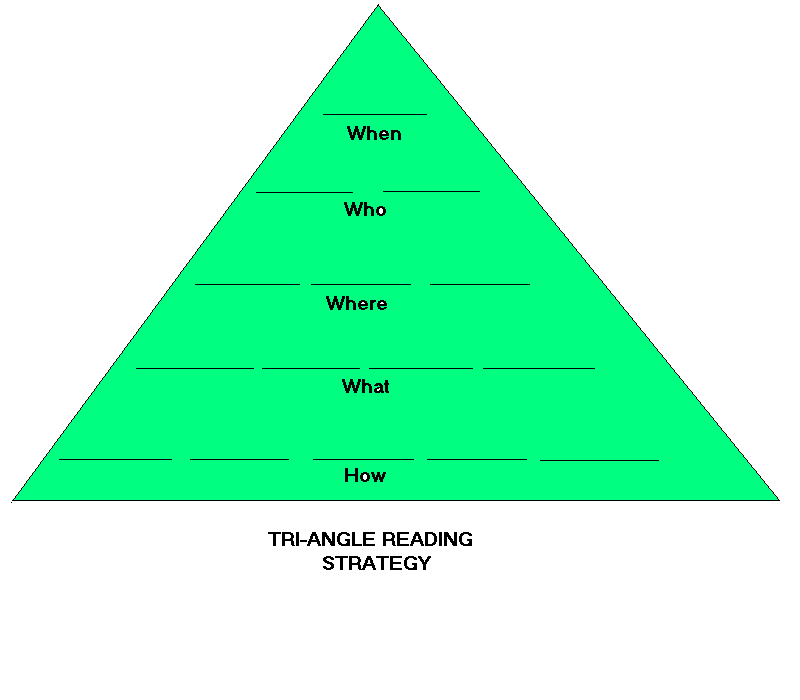
The first day of the lesson, I would present my March on Washington Newsletter to the class. (I have also provided the Newsletter's Documentation , which details the newsletter's creation process and potential uses). I would use a computer with projector capabilities, and conduct this lesson in the classroom. I would give each of my students a copy of the newsletter, and I would also project a copy on the wall from my computer, and we would read it aloud as a class. I would call on volunteers to read a paragraph each. After we completed reading the newsletter, I would give each of the students a copy of the Tri-Angle Activity Sheet. The Tri-Angle activity requires the students to reflect upon a story that they have read, and answer the questions "when" in one word, "who" in two words, "where" in three words, "what" in four words, and "how" in five words. I would explain the procedure of the Tri-Angle activity to the students and how they will answer the questions on the Tri-angle sheet about the March on Washington newsletter, and then ask them to try to fill out the worksheet on their own. Next, I would let the students give their examples about how to fill in the Tri-Angle activity sheet, and we will use these examples as a lead in to class discussion. I will ask the students to turn in their Tri-Angle activity sheet to me at the end of the class, and it will be used as an informal assessment of the students' learning and the effectiveness of the instruction.
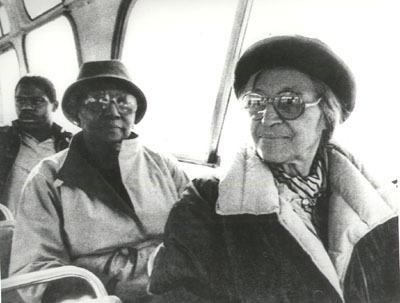
The second day of the lesson will be spent in the classroom. I am going to write on the board the topic of the day, which is "Rosa Parks." Then, I will hand out the KWL Activity Sheet. This activity sheet has a chart set up with three categories, "What you already know," "What you would like to know," and "What I learned." I will create these three categories under the Rosa Parks topic on the board. I will start off by asking the class what they already know about Rosa Parks. Hopefully, other students examples will trigger the prior knowledge of other students. Then I will ask the students what they would like to know about Rosa Parks, and I will give suggestions if the students have trouble thinking of their own examples. I will ask the students to fill out their charts throughout our discussion, and I will be filling out their suggestions under each category on the board. Once the first two categories of the chart are completed, I will hand out a copy of the Rosa Parks Web Article to each student. I will call on volunteers to read from the article. Once we have completed the article, I will ask the students to take a few minutes to fill out the last section of the chart on their own. Then, I will ask students to give their examples, and I will fill in the last chart on the board. I will ask the students to turn in the KWL activity sheet to me at the end of the class as a form of informal assessment of the students' learning and to evaluate the effectiveness of instruction.
The third day of the lesson will be spent in the computer lab. I will explain to the students that they are going to research one Civil Rights Movement Event that they would like to create a Newsletter about. I will ask each of the students to go to the Civil Rights Movement Events Website. The students will use this website only to research a Civil Rights Movement Event. I will explain to the students that they must look for information that tells the "who," "what," "when," "where," and "why" of the event, like they did with tri-angle activity that they completed. I will provide the students with notecards to take their notes on. I will go around the room and have an individual conversation with each of the students about their research process, and answer any questions they might have. As a form of assessment and evaluation of the students' ability to stay on task, I will have them turn in their topic to me at the end of the period.
The fourth day of the lesson will also be conducted in the lab. I will use a computer with projector capabilities, and create a sample Newsletter using Microsoft Word, and have the students create one on their computer along with me. I will explain to the students that they will be creating a Newsletter on the Civil Rights Movement event that they chose to research. I will allow the students the last fifteen minutes of class to finish their research and ask individual questions.
The fifth day of the lesson will be conducted in the computer lab. The students will spend the entire period creating their newsletters. I will go around the room and help students and answer questions. The students will save their newsletters on floppy disks. The students will print out a copy of their newsletters and turn them into me at the end of the period. The newsletter will be graded according to the Newsletter Grading Rubric that I have developed. The grading of of the newsletter will be a form of formal assessment of the students' learning and the effectiveness of the instruction.
TECHNOLOGIES USED
March on Washington Newsletter
Newsletter's Documentation
Tri-Angle Activity Sheet
Rosa Parks Web Article
KWL Activity Sheet
Civil Rights Movement Events Website
Grading Rubric
Other Materials
LESSON PLAN LINKS
PowerPoint Creation (Lesson Plan Two)
Unit Plan
Home