Hallstatt Culture

The first people that can truly be labelled “celtic” is the Hallstatt culture, named so for an archaeological site in Austria, 30 miles south of Salzburg, and a series of cemetary findings that date from 800-500 B.C.E. This culture was identified by language, art, and burial practices.

The Hallstatt culture spoke variations of a Celtic root language, the ancestor language of modern Gaelige and Brythonic, which survives in different forms today in Ireland, Scotland, Manx, Cornwall, Wales, and Brittany.
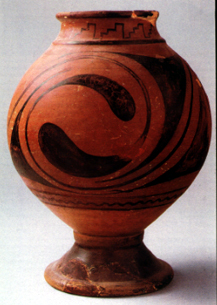
The art of the Hallstatt culture evolved out of an art form which combined aspects of several previous indo-european cultures. Much of this artwork can be identified by its strong angular designs and highly stylized depictions.
Hallstatt burial practices reflect their ancestral ties to the Kurgan culture of the Russian steppes. Kurgan is translated to literally mean "mound" in reference to their burial customs. The people of the Hallstatt culture reinstated the custom of mound burials, preserving their dead in salt. Prior to this, cremation was prevalent among the Urnfield and the Beaker Cultures.
The Hallstatt culture mined and traded salt from the local lowlands, hence the name Hallstatt (translated to HALL=salt, STATT=place) They were iron workers, shepherds, agriculturalists, and accomplished weavers of various textiles.

La Tene Culture
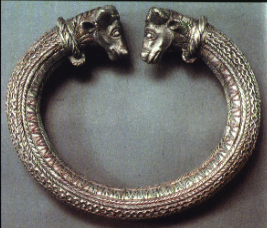
Between 500 and 600 B.C.E., there was a mass cultural change among the people of the Hallstatt. These changes were primarily in art, trade, and technology, and came to be known as the "La Tene" culture, named for an archaelogical find in the Neuenburg Lake in Switzerland. There were almost 2,000 artifacts uncovered, most of which carried a bold new type of curvilinear tendril artwork and anthropomorphic designs.

The La Tene culture is often referred to as the "Golden Age" in the Celts history. Because of advances in technology and metalworking skills, the Celts were equal to and sometimes even surpassed the technologies of Rome. It is believed by many authorities on the subject that the La Tene era was the time of the epic tales of Ireland, such as the Tain bo Cuilgne.
Among these new technologies were advances in metalworking, which resulted in the ability to produce a long, "steely" iron blade, as well as the addition of La Tene style artwork added to even the simplest everyday obects, such as horse trappings, personal items, and kitchenware.
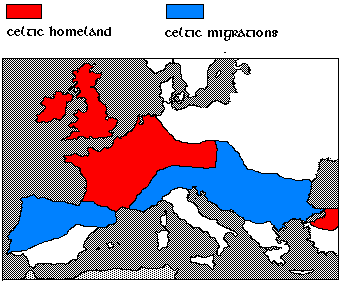
Due to these advances, the La Tene culture was able to rapidly migrate throughout Europe, including the Baltic Seacoast, the Iberian peninsula, and northern Mediterranean.
It is the many tribes of the people that we call "celt" that we are trying to explore and unravel the mysteries of. Hopefully, this introduction to the celtic culture has laid down a good foundation and helped to begin the journey of discovery to who our ancestors truly were.
 NORAID Online - Irish Northern Aid organization