
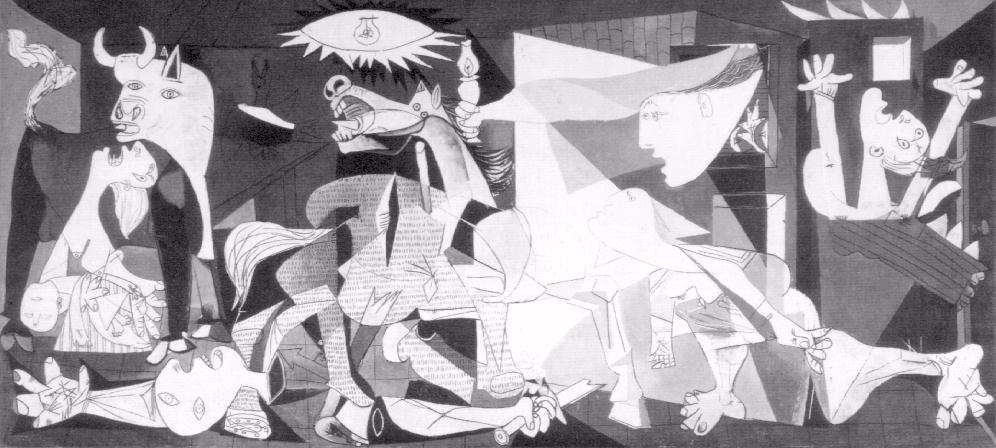
Picasso, Pablo (Ruiz y) (Spanish painter). Guernica. 1937.
Bingen on the Rhine
A SOLDIER of the Legion lay dying in Algiers,
There was a lack of woman's nursing, there was dearth of woman's tears;
But a comrade stood beside him, while his lifeblood ebbed away,
And bent with pitying glances, to hear what he might say.
The dying soldier faltered, and he took that comrade's hand,
And he said, "I nevermore shall see my own, my native land:
Take a message, and a token, to some distant friends of mine,
For I was born at Bingen, -- at Bingen on the Rhine.
"Tell my brothers and companions, when they meet and crowd around,
To hear my mournful story, in the pleasant vineyard ground,
That we fought the battle bravely, and when the day was done,
Full many a corpse lay ghastly pale beneath the setting sun;
And, mid the dead and dying, were some grown old in wars, --
The death-wound on their gallant breasts, the last of many scars;
And some were young, and suddenly beheld life's morn decline, --
And one had come from Bingen, -- fair Bingen on the Rhine.
"Tell my mother that her other son shall comfort her old age;
For I was still a truant bird, that thought his home a cage.
For my father was a soldier, and even as a child
My heart leaped forth to hear him tell of struggles fierce and wild;
And when he died, and left us to divide his scanty hoard,
I let them take whate'er they would, -- but kept my father's sword;
And with boyish love I hung it where the bright light used to shine
On the cottage wall at Bingen, -- calm Bingen on the Rhine.
"Tell my sister not to weep for me, and sob with drooping head,
When the troops come marching home again with glad and gallant tread,
But to look upon them proudly, with a calm and steadfast eye,
For her brother was a soldier too, and not afraid to die;
And if a comrade seek her love, I ask her in my name
To listen to him kindly, without regret or shame,
And to hang the old sword in its place (my father's sword and mine)
For the honor of old Bingen, -- dear Bingen on the Rhine.
"There's another, -- not a sister: in the happy days gone by
You'd have known her by the merriment that sparkled in her eye;
Too innocent for coquetry, -- too fond for idle scorning, --
O friend! I fear the lightest heart makes sometimes heaviest mourning!
Tell her the last night of my life (for, ere the moon be risen,
My body will be out of pain, my soul be out of prison), --
I dreamed I stood with her, and saw the yellow sunlight shine
On the vine-clad hills of Bingen, -- fair Bingen on the Rhine.
"I saw the blue Rhine sweep along, -- I heard, or seemed to hear,
The German songs we used to sing, in chorus sweet and clear;
And down the pleasant river, and up the slanting hill,
The echoing chorus sounded, through the evening calm and still;
And her glad blue eyes were on me, as we passed, with friendly talk,
Down many a path beloved of yore, and well-remembered walk!
And her little hand lay lightly, confidingly, in mine, --
But we'll meet no more at Bingen, -- loved Bingen on the Rhine."
His trembling voice grew faint and hoarse, -- his grasp was childish weak, --
His eyes put on a dying look, -- he sighed, and ceased to speak;
His comrade bent to lift him, but the spark of life had fled, --
The soldier of the Legion in a foreign land is dead;
And the soft moon rose up slowly, and calmly she looked down
On the red sand of the battle-field, with bloody corses strown;
Yet calmly on that dreadful scene her pale light seemed to shine,
As it shone on distant Bingen, -- fair Bingen on the Rhine.
Caroline Norton
This Poem tells of a dying solider's last wishes. To contact his family and to tell each of them that he will always be with them. A very depressing poem in that this happens all the time. Think if for every person that died in war all the people in the family, each family, where told the news.
What of their feelings to the solider, to the state for sending them to fight. This reallity is far to real. Life is just a collection of moments ending in the poem above.
The Charge of the Light Brigade
Alfred, Lord Tennyson
1.
Half a league, half a league,
Half a league onward,
All in the valley of Death
Rode the six hundred.
"Forward, the Light Brigade!
"Charge for the guns!" he said:
Into the valley of Death
Rode the six hundred.
2.
"Forward, the Light Brigade!"
Was there a man dismay'd?
Not tho' the soldier knew
Someone had blunder'd:
Their's not to make reply,
Their's not to reason why,
Their's but to do and die:
Into the valley of Death
Rode the six hundred.
3.
Cannon to right of them,
Cannon to left of them,
Cannon in front of them
Volley'd and thunder'd;
Storm'd at with shot and shell,
Boldly they rode and well,
Into the jaws of Death,
Into the mouth of Hell
Rode the six hundred.
4.
Flash'd all their sabres bare,
Flash'd as they turn'd in air,
Sabring the gunners there,
Charging an army, while
All the world wonder'd:
Plunged in the battery-smoke
Right thro' the line they broke;
Cossack and Russian
Reel'd from the sabre stroke
Shatter'd and sunder'd.
Then they rode back, but not
Not the six hundred.
5.
Cannon to right of them,
Cannon to left of them,
Cannon behind them
Volley'd and thunder'd;
Storm'd at with shot and shell,
While horse and hero fell,
They that had fought so well
Came thro' the jaws of Death
Back from the mouth of Hell,
All that was left of them,
Left of six hundred.
6.
When can their glory fade?
O the wild charge they made!
All the world wondered.
Honor the charge they made,
Honor the Light Brigade,
Noble six hundred.
Now what of this poem. You may say I added this just to fill up space. Though this is not(!) the case, it really does not belong to this theme. Only through interpretation does it fit.
Take the title, "Charge of the Light Birgade", that does not sound depressing. But if you read on Tennyson tells us of the six hundred riding into hell. Thus the view of many armies during war.
To quote my Great Grandfather, from his war diary, "General Sherman only had it half right, war is worse then hell could be".
DISASTER POEMS...
"WRECK OF THE HESPERUS"
It was the schooner Hesperus,
That sailed the wintery sea;
And the skipper had taken his little daughter,
To bear him company.
Blue were her eyes as the fairy flax,
Her cheeks like the dawn of day,
And her bosom white as the hawthorn buds,
That ope in the month of May.
The Skipper he stood beside the helm,
His pipe was in his mouth,
And he watched how the veering flaw did blow
The smoke now West, now South.
Then up and spake an old Sailor,
Had sailed the Spanish Main,
"I pray thee, put into yonder port,
for I fear a hurricane.
"Last night the moon had a golden ring,
And to-night no moon we see!"
The skipper, he blew whiff from his pipe,
And a scornful laugh laughed he.
Colder and louder blew the wind,
A gale from the Northeast,
The snow fell hissing in the brine,
And the billows frothed like yeast.
Down came the storm, and smote amain
The vessel in its strength;
The shuddered and paused, like a frighted steed,
Then leaped her cable's length.
"Come hither! come hither! my little daughter,
And do not tremble so;
For I can weather the roughest gale
That ever wind did blow."
He wrapped her warm in his seaman's coat
Against the stinging blast;
He cut a rope from a broken spar,
And bound her to the mast.
"O father! I hear the church bells ring,
Oh, say, what may it be?"
"Tis a fog-bell on a rock bound coast!" --
And he steered for the open sea.
"O father! I hear the sound of guns;
Oh, say, what may it be?"
Some ship in distress, that cannot live
In such an angry sea!"
"O father! I see a gleaming light.
Oh say, what may it be?"
But the father answered never a word,
A frozen corpse was he.
Lashed to the helm, all stiff and stark,
With his face turned to the skies,
The lantern gleamed through the gleaming snow
On his fixed and glassy eyes.
Then the maiden clasped her hands and prayed
That saved she might be;
And she thought of Christ, who stilled the wave,
On the Lake of Galilee.
And fast through the midnight dark and drear,
Through the whistling sleet and snow,
Like a sheeted ghost, the vessel swept
Tow'rds the reef of Norman's Woe.
And ever the fitful gusts between
A sound came from the land;
It was the sound of the trampling surf,
On the rocks and hard sea-sand.
The breakers were right beneath her bows,
She drifted a dreary wreck,
And a whooping billow swept the crew
Like icicles from her deck.
She struck where the white and fleecy waves
Looked soft as carded wool,
But the cruel rocks, they gored her side
Like the horns of an angry bull.
Her rattling shrouds, all sheathed in ice,
With the masts went by the board;
Like a vessel of glass, she stove and sank,
Ho! ho! the breakers roared!
At daybreak, on the bleak sea-beach,
A fisherman stood aghast,
To see the form of a maiden fair,
Lashed close to a drifting mast.
The salt sea was frozen on her breast,
The salt tears in her eyes;
And he saw her hair, like the brown sea-weed,
On the billows fall and rise.
Such was the wreck of the Hesperus,
In the midnight and the snow!
Christ save us all from a death like this,
On the reef of Norman's Woe!
By Henry Wadsworth Longfellow.
This poem of a ship wreck at sea does little more then tell of a skipper at the helm and his daughter tied to a mast, and them both dying.
Nature like in the before this one, conqures, but in this one it conqures a little scooner and killes everyone on board. Though most of my poems have been along the theme of death, isen't that just the extreme of my topic.
What more can despiar and depression bring then death.