

Robert K. Smyth
July 27, 1927 –
Grumman Test Pilot - Flight No. 24
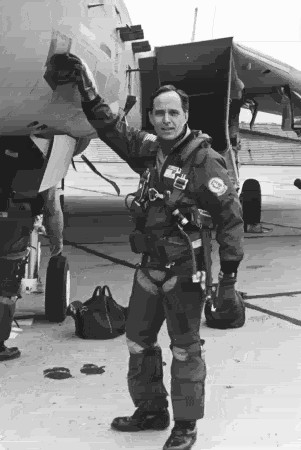
Bob Smyth was born in New York City on July 17, 1927. After one semester of college, he entered the U.S. Navy in June of 1945. While serving in the U.S. Navy, Bob furthered his college education and entered Naval Flight Training. He graduated in 1948.
Bob was assigned to both fighter and night fighter squadrons flying Grumman F8F Bearcats, Chance Vought F4U Corsairs, and McDonnell F2H Banshees. He graduated U.S. Navy Test Pilot School in 1952, and served as exchange officer with the British Royal Navy flying De Havilland DH-112 Sea Venoms in 1953-54.
In 1955 Bob resigned his commission from the U.S. Navy and accepted a position as an Engineering Test Pilot with the Grumman Aircraft Engineering Corporation. He flight-tested the F9F Cougar and F11F Tiger series, and participated in Gulfstream I Test and Certification program from 1955 to 1960.
Bob performed the first flight of the A2F-1 (A-6A) Intruder in April 1960 and continued with the test phase of the program until November 1962. He was then appointed as a consulting pilot and astronaut liaison on the Apollo Lunar Module program. In the spring 1966 he left the LM program and became the project pilot for the Gulfstream II, Grumman’s entry into the corporate jet market. Bob performed first flight on the Gulfstream II in October 1966 and participated with its test and certification program.
In 1967 Bob was appointed Chief Test Pilot for Grumman. Several years later on December 21, 1970, along with fellow Grumman Test Pilot Bill Miller, he performed the first flight of the best fighter aircraft ever produced, the F-14A Tomcat. He also holds the distinction, as well as Bill Miller, as the first crew to eject from an F-14 on December 30 just a little over a week from first flight. In 1972 Bob attended a program for Senior Executives at MIT, and was named Director of Flight Test in 1974. He was also the project pilot for the Gulfstream III, performed first flight in December 1979, and continued with its test and certification program.
Bob left Grumman in 1981 and joined the Gulfstream Aerospace Corporation in Savannah, Georgia as Director of Flight Operations. In 1985 he was promoted to Vice President of Flight Ops and Quality Control. Bob also participated in most of the Gulfstream III and IV record setting flights around world, over the poles, etc.
Some of Bob’s accomplishments in aviation include certified Airline Transport Pilot (G-I, II, III, and IV), and single engine land, multi-engine land and sea aircraft. He is a Fellow of Society of Experimental Test Pilots, and was elected to the Carrier Test Pilots Hall of Honor, on board USS Yorktown, Charleston, SC in 1991.
In June of 1993, Bob retired from the Gulfstream Aerospace Corporation. He currently resides in Ocala, Florida.
J. Thomas Gwynne
Grumman Test Pilot - Flight No. 72
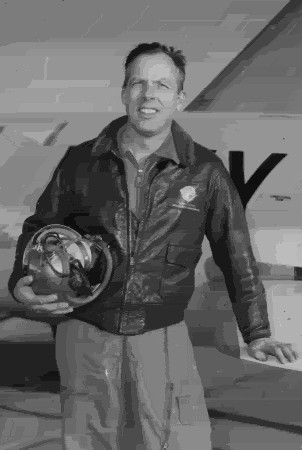
Tom Gwynne was born and raised on Staten Island, New York. He attended the Staten Island Academy and subsequently Brown University where he graduated with a B.A. degree majoring in International Relations.
Following graduation from Brown University, Tom was commissioned an officer in the United States Air Force and attended pilot training in Alabama. He served as an F-4 Phantom fighter pilot for six years, including a combat tour in Vietnam where he earned two Distinguished Flying Crosses and ten Air Medals.
Tom left the Air Force and on January 27, 1969 joined the Grumman Corporation as a consultant on the Apollo Program. In 1972 he joined the Flight Test Department in Calverton and spent the next 15 years as a pilot for Grumman’s tactical aircraft production line, test flying the F-14 Tomcat, A-6 Intruder, EA-6B Prowler, EF-111 Raven, OV-1 Mohawk, and Gulfstream III aircraft.
On July 6, 1979, Tom performed first flight on F-14A (160902) shop number 331, the very aircraft that has become the centerpiece of Grumman Memorial Park.
In 1989 Tom was appointed Director of Flight Operations at Calverton and held that position until 1994 when left to become Operations Manager for Grumman’s St. Augustine, Florida facility. He retired from Northrop Grumman in early 1997.
Tom returned to New York and in July of 1997 was appointed Senior Planning Manager for the Cradle of Aviation Museum at Mitchel Field, New York. The museum was closed for several years and Tom guided it through its expansion and major renovations. Prior to the grand opening on May 20, 2002, Tom was appointed Vice President for External Relations for the Cradle of Aviation Museum. Corwin H. Meyer
May 14, 1920 -
Grumman Test Pilot – Flight No. 25
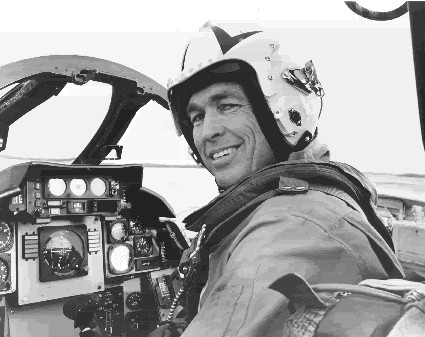
Corky Meyer was born on May 14, 1920 in Springfield, Illinois. After High School he attended the University of Illinois and went on to M.I.T. Corky received his flight training and obtained his commercial, instructor, instrument and multi-engine ratings from the Civilian Pilot Training Program in
1940 – 42.
After working as a trainee for Pan American Airways, Corky joined Grumman in 1942 and soon became the project pilot for the F6F Hellcat, F7F Tigercat, F8F Bearcat, F9F Panther, XF10F-1 Jaguar, and the F11F Tiger series.
He has flown many of the high-performance aircraft made in the 1940s including a Japanese A6M Zero.
In 1947 Corky performed first flight of the XF9F-2 Panther, Grumman’s first jet fighter. He was head of Grumman Flight Operations at Edwards Air Force Base from 1952-56. In 1954 he became the first civilian pilot to qualify aboard an aircraft carrier, when he landed aboard USS Lake Champlain (CVS-39) flying an F9F-6 Cougar.
In 1967 Corky was elected Vice President of the Grumman Aircraft Engineering Corporation guiding the company through its many reorganizations. In 1969 he was elected to the board of directors of the Grumman Aerospace Corporation, and in 1972 became senior Vice President of GAC. In 1974 Corky became President and CEO of Grumman American, a commercial aircraft subsidiary. Before he retired from his 36-year career with Grumman in 1978 Corky had tested and evaluated more than 125 different types of both military and commercial jet and piston-engine aircraft. He continued his career in aviation as president and CEO of the Enstrom Helicopter Corporation and later Falcon Jet Corporation.
Corky was inducted into the Carrier Aviation Test Pilots Hall of Honor at Patriots Point Naval and Maritime Museum in Charleston, South Carolina in 1995. On May 9, 1997, at a banquet held at the National Museum of Naval Aviation, Pensacola, Florida, he was named Honorary Naval Aviator No. 23.
His other achievements include being a founding member, as well as a Fellow of the Society of Experimental Test Pilots (and accepting the James H. Doolittle Award in 1971), an Associate Fellow of the American Institute of Aeronautics and Astronautics, the Wright Stuff Association – Wright Field World War Two Test Pilots Association, the Early and Pioneer Naval Aviators Association of Golden Eagles, and the Aerospace Walk of Honor.
Corky is enjoying his retirement from his over 50 years of test flying and currently resides in Ocala, Florida. Charles A. "Chuck" Sewell
1930 – August 4, 1986
Grumman Test Pilot – Flight No. 02
Born in 1930 Chuck Sewell attended the College of William and Mary, George Washington University, University of Maryland and New York Institute of Technology.
He spent twenty years in the United States Marine Corps first as a fighter pilot and then as a test pilot. Chuck flew 110 combat missions in Korea and was shot down once by enemy ground fire. He also spent four months with the First Marine Division as a forward air controller. After Korea he became an exchange pilot with No. 74 Squadron, Royal Air Force and spent two years as a Flight Commander.
Chuck also flew with the Red Arrows, England’s Premier Air Demonstration Team. Upon return to the US, Chuck attended the US Navy Test Pilot’s School and spent four years at the Naval Test Center in Patuxent River, Maryland. During the Vietnam War, he commanded a US Marine Corps squadron of F-4
Phantoms and flew 220 missions over North and South Vietnam as well as Laos. Chuck retired from the Marine Corps in 1969 as a Lt. Colonel with the following decorations: Legion of Merit with Combat "V", two Distinguished Flying Crosses, fifteen Air Medals, two Purple Hearts and the Vietnam Cross of Gallantry.
Chuck joined the Grumman Corporation in 1969 as an Experimental Test Pilot based at the Calverton Flight Test Facility. In 1971 he was appointed to the position of Grumman’s Chief Test Pilot.
During his career with Grumman, Chuck flew almost every type of production aircraft including the A-6 Intruder series, EA-6B Prowler, EF-111A Raven and X-29 Forward swept wing aircraft, performing first flight at Edwards AFB in 1984. However, Chuck Sewell is probably best remembered for his association with the testing of the F-14 Tomcat. Many flight regimes were explored by Chuck, but one that deserves mentioning is the series of asymmetrical wing sweep tests on F-14 No. 3 from December 19, 1985 to February 28, 1986. By keeping one wing at full forward position and the other in various sweep modes he proved that the Tomcat could perform under these peculiar conditions. This aircraft is presently on display at the Cradle of Aviation Museum in Mitchel Field. On many occasions Grumman’s president, George Skurla could be found sitting back seat in F-14 #7 with Chuck at the controls. Chuck’s other accomplishments include being a Fellow in the Society of Experimental Test Pilots, and former head of the SETP Flight Test Committee. He was a holder of the Ivan Kincheloe Award for Test Pilot of the Year from the SETP in 1973 and again in 1984. Chuck also won the Best Technical Paper of the Year Award from STEP in 1979, 1982 and 1983. In 1974 he was the winner of the Octave Chanute Award form the American Institute of Aeronautics and Astronautics and in 1983 was awarded the Lawrence B. Sperry Award from the US Air Force Association in 1981.
Chuck’s love of flying went beyond high-performance military jets. He had more than 10,000 hours in over 140 types of aircraft. Flying vintage World War Two aircraft was a favorite of Chuck’s. However tragedy struck when on August 4, 1986 Chuck was killed in a crash of a friend’s Grumman TBM Avenger torpedo bomber while attempting to take off from Connecticut en route to Florida. Incompatible fuel was determined as the cause of the accident. Chuck left behind a legacy at Grumman, as well as many of the employees who admired him and called him a friend.