Home Hitler Stalin
Zhukov RussiaThe War
Bibliography
Home Hitler Stalin
Zhukov RussiaThe War
Bibliography
|
| Stalin, Joseph (1879-1953) |
|
| Home Hitler Stalin
Zhukov RussiaThe War
Bibliography
|
|
|
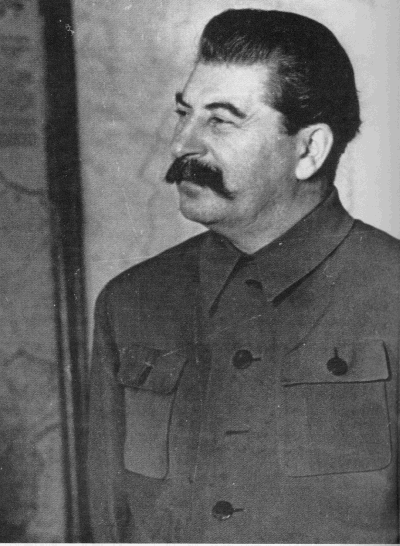
Joseph Stalin was born in Gori, Georgia on December 21, 1879 and was the fourth child born in four years however, the first three died and Stalin was prone to poor health so his mother grew overprotective towards him as a child. At the age of seven Stalin contracted smallpox, he survived but his face was permanently scarred for the rest of his life and other children cruelly called him "pocky." In May, 1899 Stalin was expelled from the Tiflis Theological Seminary for trying to convert fellow students to marxism, developed by Karl Marx. Stalin then began writing articles for the socialist Georgian newspaper Brdzola Khma Valdimir. In 1901 Stalin joined the Social Democratic Labour Party and helped organize an industrial resistance to Tsarism. He was caught in 1902, spent a year in prison and later exhiled to Siberia in 1904 where he eventually escaped captivity. Later that year he married his first wife, Yekaterina Svanidze, who died six years later in 1910. In total Stalin was arrested eight times, escaped six times and was exhiled for the last time in 1913 and released in 1917. Between 1905 and 1917 Stalin was more of a follower than a leader and supported the Bolshevik party. In 1907 he helped the organization hold up a bank in order to "expropriate" funds. Lenin, the leader of the Bolshevik's, co-opted Stalin to edit the new party newspaper Pravada (Truth.) Stalin later wrote his first major work Marxism and the Natioality Question. In 1922 Stalin became secretary general and after Lenin's death he joined in a troika with Zinovyev and Kamenev to lead the country. With his new allies he had his archrival Trotsky and his supporters expelled from the party and exhiled. In 1929, at the age of fifty, Stalin became the leader of the USSR and began his nationwide offensive against the peasentry as millions were displaced and killed. By the mid-thirties Stalin launched a major campaign of political terror which touched almost every family as loved ones were deported to labour camps. World War Two cost the Soviet Union millions of lives and several suffered greatly as Stalin directed the war at Nazi Germany dispite signing the Non-Agression Pact with Hitler in 1938. After the German invasion in 1941 Stalin joined his country with the Grand Alliance as he resumed the title of generalissimo. After the war Stalin continued to extend Communist domination over most countries that were liberated by Soviet forces. In his last years Stalin became extremely paranoid and physically weak and in January, 1953 he ordered the arrests of all Jewish doctors practicing in Moscow and charged them with madical assassination. Fortunately the sudden death of Stalin later that year halted another bloodbath. A few years after Stalin's death, Nikita Khrushchev, the new leader of the Soviet Union made a speech at the Twentieth Party Congress. He attacked the policies of Stalin and revealed how Stalin had been responsible for the execution of thousands of loyal communists during the purges and in the months that followed Khrushchev's speech thousands of people imprisoned under Stalin were released. Those who had been in labour camps were given permission to publish their experiences and the most notable of these was Alexander Solzhenitsyn whose powerful novel, One Day in the Life of Ivan Denisovich, became a world-wide bestseller.
|
|