|
The Southern Railway was the smallest of the big four railway companies
established at the grouping in 1923. The companies which joined up to form the
SR were The London, Brighton and South Coast Railway, the London and South
Western Railway and Chatham Railway.
The SR stretched from London to all along the south coast to places like
Southampton, Bournemouth and Brighton, up until it reached the boundaries of the
GWR in Exeter. Very rarely did any SR engines venture north of Swindon or
Oxford.
The SR were well known for the passenger services they ran to Southampton
called the boat trains or Pullman services with elegant named trains like The
Golden Arrow, people could then catch a boat to the Isle of Wight or even
France.
The SR also developed the continental & Channel Islands shipping services which had been operated by
its constituent railways. After replacing vessels lost on war service, by 1931
the SR fleet comprised 44 ships on cross-channel services & 12 Isle of Wight
ferries. In 1930 Parliament rejected the proposal for a Channel Tunnel & the
SR embarked, in association with the Nord Railway of France, upon building train
ferry ships to carry both wagons & the Night Ferry sleeping car service
operated by the International Sleeping Car Company. The Night Ferry & the
Golden Arrow partially succeeded in meeting the new airline competition.
Also this railway was the first to use electric on some of its lines and this
was in the 1920’s, when steam was still in full flow.
R.E.L.Maunsell & O.V.S.Bulleid were the main locomotive designers for the
Southern Railway, but Bulleid designed the more powerful express engines, like
the Merchant Navy and Canadian Pacific classes.
The SR was heavily engaged during World War II with armed services traffic
(especially during the Dunkirk evacuation & the D-Day landings) &
suffered severely from bombing raids from Germany.
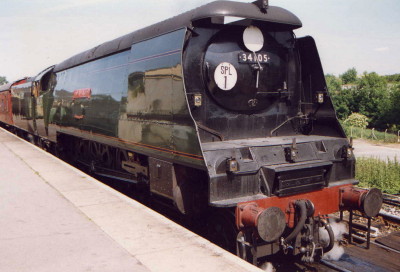
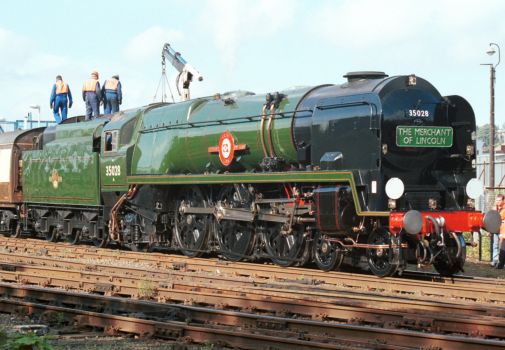
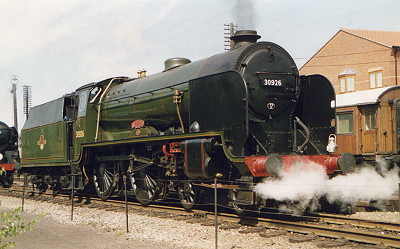
Below are some images of Southern Locomotives, click
the image to view it full size.
|