
All text and images are protected under U.S copyright law.
Do not use without permission.
Some people claim that Homo erectus and Homo ergaster are human. And while their anatomy is similar in some areas, the differences are too great for these creatures to be classified as humans. Homo erectus is an extinct ape, not a human and not a human ancestor.
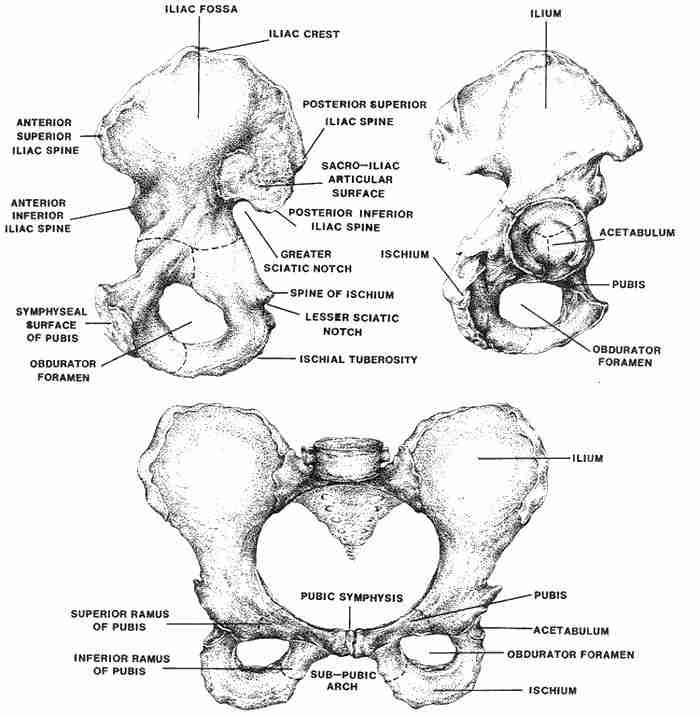
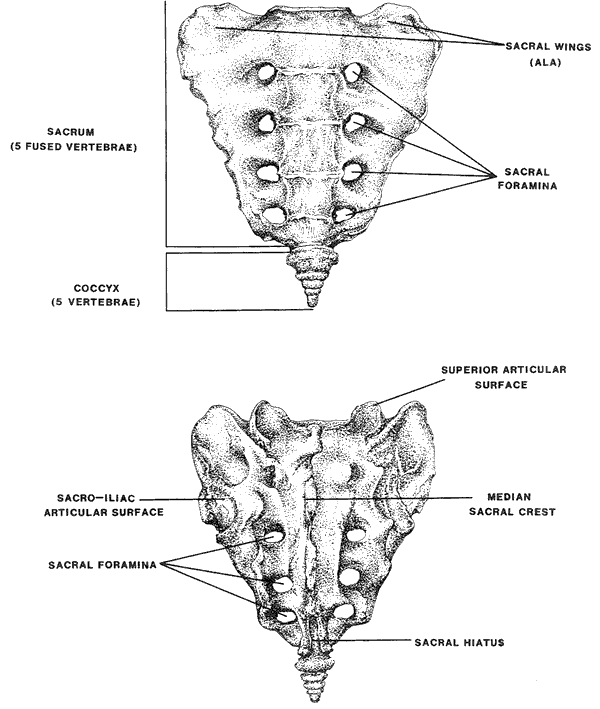
This chapter will deal with the difference in pelvic structure of Humans and Homo erectus.
This world is in a downward spiral. God created it with great design and complexity. When Adam sinned it started to degenerate. We can see the effect this has has on both humans and on primates.
Australopithecines started out with a pelvis that was similar to those of humans, and allowed them to walk upright. However, after man (Adam) sinned, they degenerated and lost this ability (see chapter _).
Other apes like Homo erectus never lost this ability.
"the hip bone displays lateral flare of the iliac blade, a very prominent vertical iliac pillar, and a strong acetabulosacral buttress. The auricular surface is relatively small, and the ischial tuberosity faces laterally as well as posteriorly. At least some of these characters of East African Homo erectus occur also in pelvic bones thought to represent an archaic form of Homo sapiens."
Rightmire
pg 175-8
THE ANATOMY OF HOMO ERECTUS
"The pelvic morphology is also distinctive in having a large acetabulum, a stout acetabulocristal buttress and medially rotated ischial tuberosities. The recognition of this femoropelvic complex of features has disposed of the view held earlier that Homo erectus was essentially sapient in its postcranial features." Day 1986 pg 410
The following pelvic specimens attributed to Homo erectus will be discussed in this section: Arago XLIV, OH 28, KNM-ER 3228 and KNM-WT 15000
| A left hip bone (Arago XLIV / 44) along with three femoral fragments (Arago XVIII / 18, LI / 51 and LIII /53) a fragment of a tibia (Arago XLIX / 49) were also found near the village of Tautavel, France. (all found after 1964)
The hip and femora* are all consistant with attribution to Homo erectus and resemble other erectus remains from Olduvai (OH 28), Koobi Fora (KNM-ER 3228) and Peking, China (Day 68, pg 52, 53). *femora: |
 Arago XLIV |
In East Africa another hip bone "OH 28" (Olduvai hominid 28)* was found in 1970. (Day, 86, pg 177).
*In addition to the hip bone, a left femoral shaft from the same individual (also labeled OH 28, see chapter __) was recovered.
The partial pelvis of OH 28 consists of the lower portion of the left ilium, and part of the ischium.
Neither the body of the pubis or the ischiopubic ramus is preserved in OH 28. The sciatic notch of OH 28 is about 30 percent wider than that of WT 15000, suggesting that this specimen is female.
|
OH 28 represents an adult female Homo erectus (pg 224 Nariokotome).
|
 OH 28 |
Differences due to sex and maturity can be seen in the pelvis (Walker pg 224, Nariokotome).
Day (M. H. Day 1971 postcranial remains of Homo erectus from Bed IV, Olduvai Gorge, Tanzania, Nature 232:383-7) notes many features which distinguish OH 28 from a modern Homo sapien. I will elaborate on this once I receive a copy of this article.
Puncture wounds from the teeth of a carnivore appear on both the pelvis (Walker, Nariokotome pg 224) and femur.
Again, we can not place this before Genesis 3, as no carnivorous activity occurred prior to the fall of man
| KNM-ER 3228 was discovered in 1975 (Day, 86, pg 215). It is a fairly complete hip bone (os coxa) from the right side of a pelvis. Comparison with KNM-WT 15000 confirm that KNM-WR 3228 is also from a male individual (Nariokotome, pg 224)
The size of the acetabulum indicates a large femoral head for this individual. The ischium (lower portion of the pelvis) is rotated medially. |
 |
Prior to the discovery of KNM-WT 15000 (Turkana boy, Nariokotome) the size of the pelvis was based on estimates from partial remains. With Kamoya Kimeu's discovery of this nearly complete skeleton in 1984 our knowledge greatly expanded. WT 15000 preserved the sacrum and both illiums.
The amount of illiac flare in this specimen is remarkable and consistant with the extreme length of the femoral necks (which in turn are very similar with those of Australopithecines)
("Early Homo erectus skeleton from west Lake Turkana, Kenya" Brown, Harris, Leakey, Walker. Nature, vol 316, August 29, 1985).
| Here is the Homo erectus pelvis (Turkana boy) as shown in Walkers monograph on Homo erectus. |  |
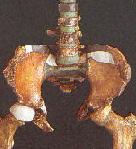
| Shown here is the right side of the Turkana boy pelvis (posterior view) that I purchased. The black parts are reconstructed or mirrored from the left side. | 
|
This pelvis belongs to a creature just as much an ape as Lucy or H. habilis. It's resemblance to a human like pelvis coincides with the original complexity (now lost since the fall of man) in the Garden of Eden.
Lubenow and others are incorrect when they say that erectus was human, and that Neanderthal and erectus are one and the same.
Neanderthal had a larger pelvis than we do, and we had a larger pelvis than erectus.
We do not have a pelvis of Homo habilis to make a comparison. We can get an idea of how habilis stood based on the foramen magnum and also the femurs (like KNM-ER 1481).
"... there is no known pelvis of the preceding species, Homo habilis, we cannot determine whether habilis's pelvis was appreciably different from erectus's"
Alan Walker "Wisdom of the Bones" pg 240
Humans require longer periods of care (after birth) than other primates. Most of a humans brain growth occurs after birth.
"Humans are unique among primates in having secondarily altricial infants. All other primates change their steep fetal rate of brain growth to a slower one at birth"
(pg 227 Nariokotome Homo erectus skeleton by Alan Walker)
Other primates are born with about 1/3 to 1/2 of their adult brain size. Humans have a fast rate of brain growth during their development, which continues until the first birthday. (pg. 227 Nariokotome)
It appears that erectus had secondary altricial neonates like modern humans (pg 233 Nariokotome). But whereas a modern human is born with a brain size of about 384 grams, erectus is 200. (pg 233 Nariokotome)
According to Donald Johanson, Homo ergaster and Homo erectus has a pelvis that is more narrow than our own. ("From Lucy to Language")
I will add more info from pg 78 of "From Lucy to Language" on WT-15000's pelvis.
Erectus seemed to hold on to his narrow birth canal. Since we have larger brains than Homo erectus, in order for us to have evolved from erectus, then erectus would have had to develop a wider birth canal first to allow the larger brained infants to pass through it.
The erectus pelvis falls outside the range of variation in H. sapiens. Neanderthals have a larger pelvis than we do (they are a more complex version of us). Erectus on the other hand had a pelvis even smaller than ours, and much much smaller than neanderthals.
Part of the pelvis of the Homo erectus specimen 1808 also exists but it is diseased, and distorted.
The bones of KNM-WT 15000 gave us a much clearer picture of these important post-cranial bones. For the first time an estimate of the birth canal size of Homo erectus could be made.
Comparing KNM-WT 15000 with OH 28 we see a degree of sexual dimorphism (sexual dimorphism is the physical difference between males and females of the same species - men being taller than women would be an example)
Alan Walker and Christopher Ruff conclude that: "The amount of sexual dimorphism in pelvic size and shape was about the same in this species as that seen in modern human populations." (Nariokotome pg. 231)
A computerized comparison of the profile of the KNM-WT 15000 hip shows that it is closer to that of the KNM-ER 3228 male hip than it is to the male homo sapien. (see pg 231 Nariokotome)
If Homo erectus was human, as Dr. Lubenow states ("Bones of Contention") then we would expect the pelvis of Homo erectus to be most simliar to the Homo sapien pelvis.
There are many similarities in the pelvis of Homo erectus and the Australopithecines. There is no question, they were both very different creatures but both walked upright. A Homo habilis pelvis is needed for comparison, and hopefully one day one will be found.
If the erectus pelvis is more similar to the pelvis of Homo habilis this would be more evidence that Homo erectus was a bipedal animal rather than a human.
If you have any questions on Creation, Evolution, or just want to say "Hi" please feel free to email me.
 | Main Index | Ape-man Index |