Check out my new Mountain Horned Dragon Care SheetClick Here
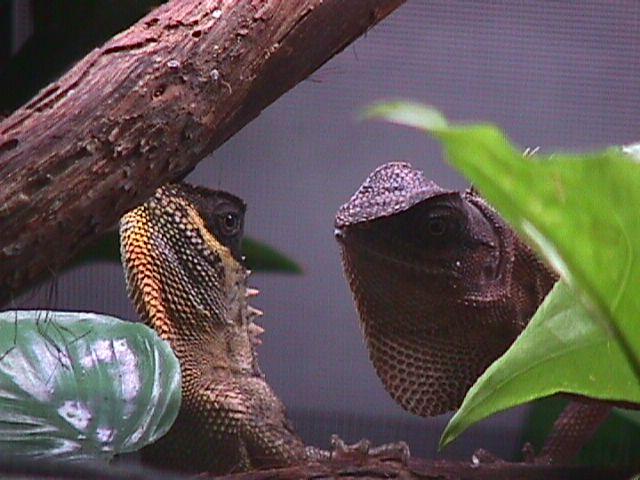
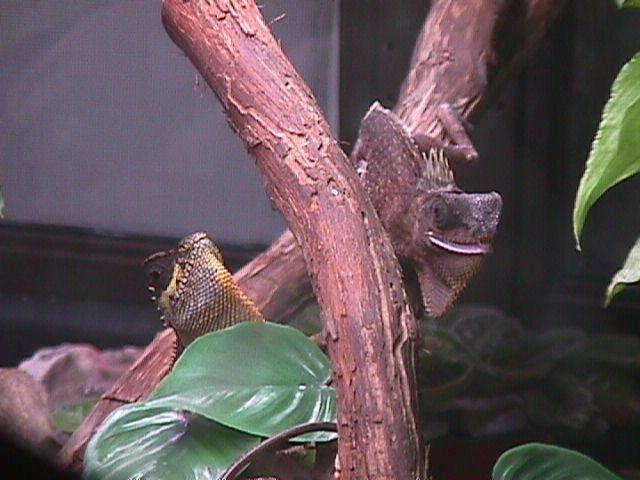
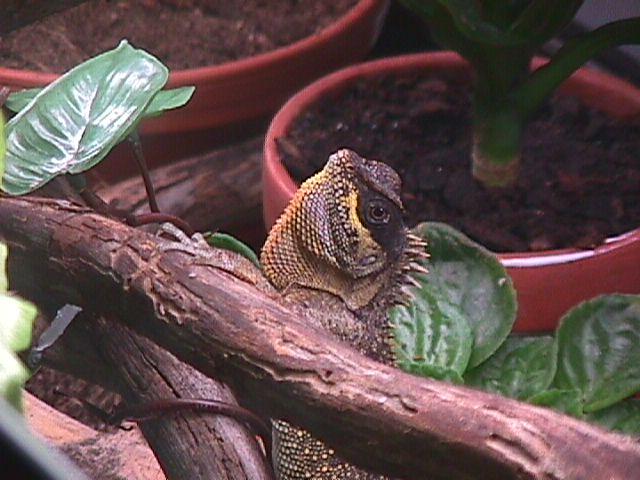
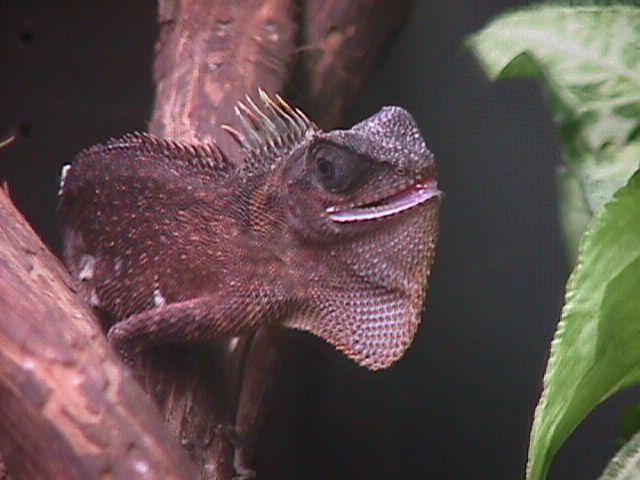
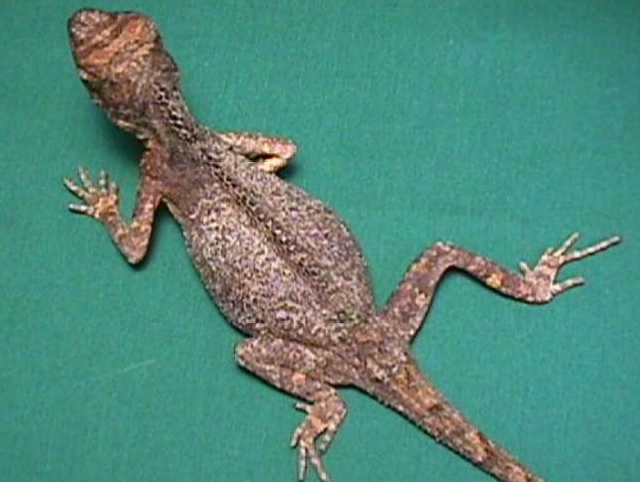
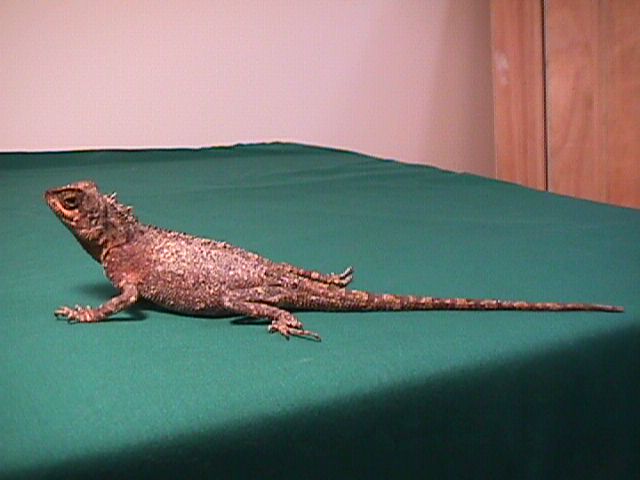
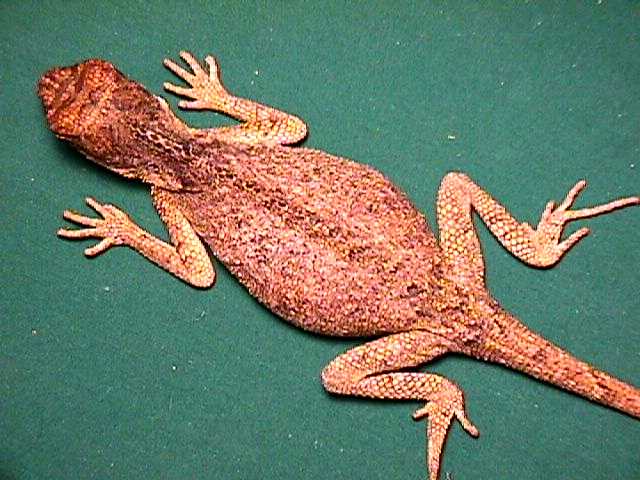
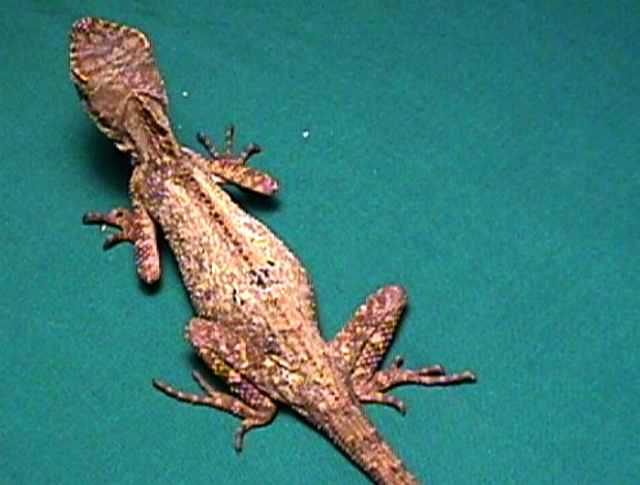
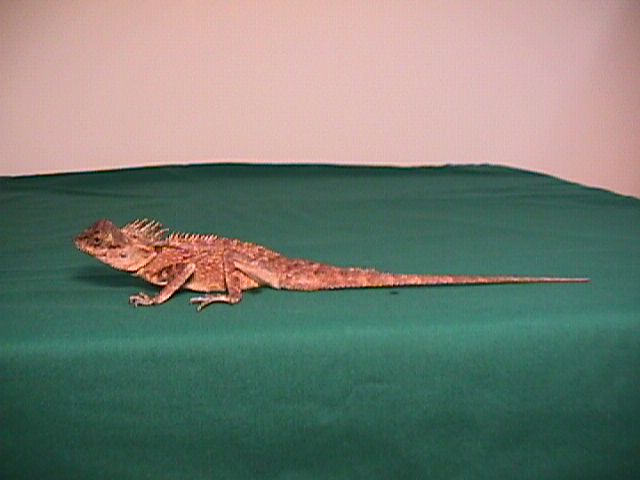
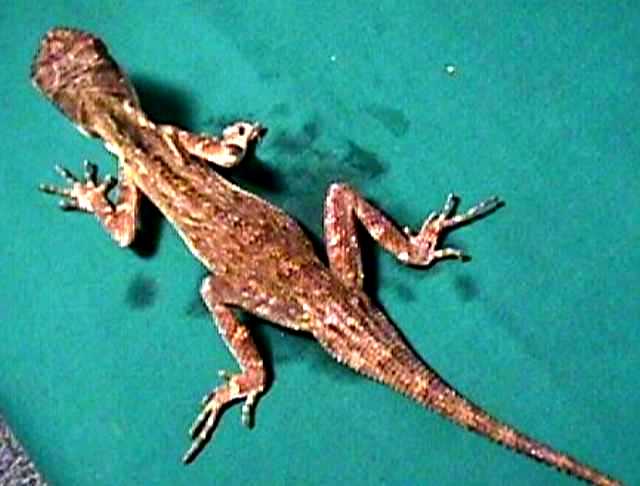
These are our Mountain Horned Dragons (Acanthasaura capra) also called Mountain Horned Lizard and Giant Mountain Lizard. We got off to a rough start with three of these guys and they all had internal parasites. After taking them to two different vets, we got them cleaned up and gaining weight. These guys only weigh about 2 1/4 oz. each and are 10 - 11 inches long head to tail.
We started in May of 1999 with 2 females and 1 male, but lost one female. She seemed to thrive in a separate tank, but back in the terrarium she became submissive and quit eating and finally died. I believe this may have been the result of a bacterial infection. Darrell had to go through one more treatment for bacteria following this loss and seems to be doing well now. The remaining female is named Darla.
In Sept. 1999 we acquired another female. Her previous owner said she had laid eggs. The eggs didn't hatch and he lost his male. Dixie is a beautiful specimen with lots of yellow in her face. We had her checked out immediately and she was found to be free of parasites and bacterial infection. She appears to be very healthy and active.
In October of 1999 we purchased a sub-adult female from a local pet store. Once treated for parasites she is vigorous and healthy, almost impossible to handle. Thus we introduced Daphne, also Daffy for short!
In May of 2000 I came across a juvenile female with horns intact and couldn’t help but buy her. The next morning I found her dead in her tank. When I returned her to the shop, they only remaining MHD was a beautiful juvenile male without horns, so I made the exchange and brought home Dexter.
In June I lost Darla, my sole female from the original trio. I was heartbroken. I now had 2 males and only 2 females. So, in July, when the pet shop got in a juvenile female. I brought home Darcy!
These guys are totally insectivorous and thrive on a diet of dusted crickets, super worms, occasional mealworms, and earthworms. I find that their preferences vary. I guess that too much of any one thing can get to be boring even for a lizard! Darla had always gone nuts over the superworms, and Dixie seems to prefer them too. Darrell has always preferred crickets, but recently has refused them and shows a preference to the superworms and earthworms too. Dixie is such a hearty eater that she sometimes gobbles the crickets 2 and 3 at a time, whatever she can catch in a mouthful! Summer of 2000 I began raising silk worms and they seem to love them. My first hatch is just reaching 1” to 1 1/4” long, but they seem to be large enough that the dragons find them tempting.
I have my dragons housed in a large terrarium/greenhouse that I picked up at a yard sale for $50.00. I think it was the buy of the century. This is 4' long, 2' deep and just over 2' tall. This structure is made up of panes of glass, eight of which slide on tracks, in an aluminum frame that sits on a plastic tub/planter base. The entire unit then sits on a wooden storage base. The top of the unit has a 2 bulb, 4' florescent light fixture with a built in timer. I am using one UVB and one regular bulb and use no additional heat source. At one time I did have a basking spot set up, but they never used it and were seldom in that end of the terrarium. The daytime temps are in the low to mid 80's and the nighttime temps drop to mid to upper 70's. I have a plastic dish pan with a power head to filter and move the water in one end of the terrarium and have placed several potted plants throughout to help keep up the humidity and provide plenty of hiding places. There is also a large grapevine I collected locally and cleaned up for them to climb on.
Our Mountain Horned Dragons seem to be very sociable, sometimes lying on top of each other. I am just as likely to find Darla and Dixie sharing a branch as I am to see Darrell and Darla or Darrell and Dixie. They seem to like to sleep in the same area, often on top of each other, and almost always on adjacent branches.
As for human association, they all seem to have different personalities. Darrell seem s to be the most accepting of human contact. He is my mellow, laid back guy and at times seems to enjoy attention. Darla is unpredictable. Sometimes she is content to sit on my shoulder, other times she will display and hiss while scrambling to the top of my head. Quite intimidating, but harmless. Dixie is still adjusting. She seems to be the most active of the trio. She will let me take her out for weigh-ins and to clean the habitat, but not without putting up a fight. She hisses and displays standing as tall as she can raising her body as high as possible. She has even threatened to bite, swinging her head around to hit my hand, mouth open and in full display. Both she and Darla will try to brush my hand away by kicking with their back legs, similar to a dog scratching itself.
We had a busy breeding season in 1999 but due to lack of information on incubation most of eggs from 6 clutches were lost. There were 2 clutches, one per female that was not fertile. Once the correct incubation temps were achieved it was discovered that incubation can vary dramatically. I now have 3 babies from the last fertile clutch that Dixie laid in March 2000. They hatched at about 145 days. The first baby from Darla’s last clutch hatched on 9/5/2000 at 161 days and the second hatched on 9/13/00 at 169 days, and the third hatched 2 days later on 9/15/00 at 171 days.
I have lots of pictures of my little ones. You can view these in my Yahoo photo album by clicking here.
I am really looking forward to next hatching season! These guys are really great and just like their parents, each has tons of personality and spunk! These are very endearing animals!
In December, I was blessed with six more Juveniles. They are just spectacular and when they display their colors are wonderful! It has taken a little time to get them settled in, but I have had them a month now and they are really starting to eat well! I feel really confident that they are strong and will be a great addition to my group.
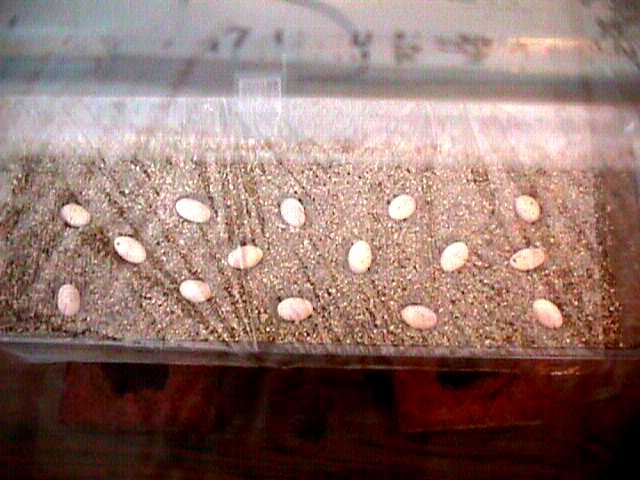
We have been blessed with many eggs for 2001 hatching. Darcy was a real surprise when she presented us with 10 eggs on 10/8/00. We had only had her for 3 months and gestation is 4 months so her offspring will be unrelated to any of our males.
Then, on 11/19/00, Daphne laid her first clutch. Another surprise, this was a record count of 19 eggs! All seem to be fertile, too!
Then last, but not least, Dixie laid 18 eggs. Two were not fertile and we are still waiting to tell about the rest.
After we knew the mating had taken place, Darrell was removed to a separate tank so the girls would not be put through what they endured last season, laying four consecutive clutches each for Dixie and Darla. We believe this was the cause of our losing Darla and want to prevent a repeat.
In spite of Darrell being removed long before Daphne laid her first clutch, she began looking quite bloated and gained a considerable amount of weight for her size. She laid her second clutch on 1/27/01. This confirms my suspicions that this species retains sperm for multiple clutches. Darcy also laid a second clutch on 1/27/01
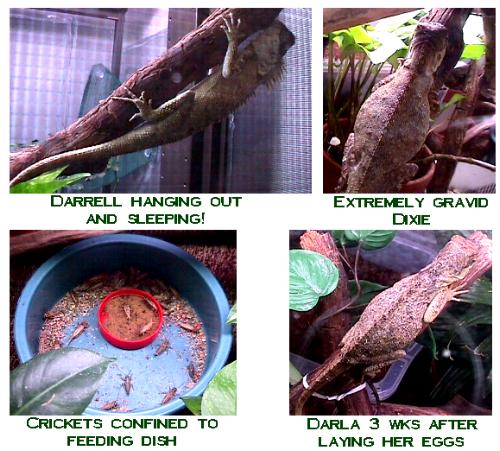
Following are some photos of my dragons with comments. I will try to keep this current and will post any changes, addition, etc.
At the bottom of the page is a list of links to the only other references I have been able to find on the web pertaining to Mountain Horned Dragons. If you know of any other sites, please let me know so I can update my links.
The Most Frequently Asked Question I See Is:
"DO I HAVE A MALE OR FEMALE?" To answer this question, follow this link:  Gender
Our Dragons