 |
||
       |
A Queen's Wardrobe
Now that you know a little more about the Queen of Camelot, you can dress up like her for a festival, play, or party. Below are a sample of some sewing patterns you can get to create you costume. They each vary in difficulty, but each offer thier own variations to try. These patterns can be found at your local fabric store or online. Most are fairly easy to make and use modern meaurments and techniques. Sewing pattern pictures courtesy of Sewing Patterns.com.
What to look for in a costume:
Costumes should be long, at least floor length. Princess seams are a great way to get the "medieval" look. Sleeves should be long, but can vary from straight to large trumpet sleeves. As for color, go for beautiful, royal looking colors, I wouldn't use any neon or cheesy prints, or anything TOO bright. For fabrics, I wouldn't use any synthetic material like knit, it wouldn't look right. Also, to help you costume look more authentic you can use grommets instead of zippers.
Hair should be either worn down long and loose or up in a braid or medieval style. Jewelry with a celtic or medieval/renaissnance style.
Links with more info
Butterick Patterns
Trim sites:
Calontir TrimLots of beautiful historical trim
Rentrim.comBeautiful renaissance and medieval trim.
CheepTrim.com A great site to gets whole spools of trim.
Other costume sites
Moviecostumes.com Makes lots of beautiful costumes, including Mists of Avalon and First Knight.
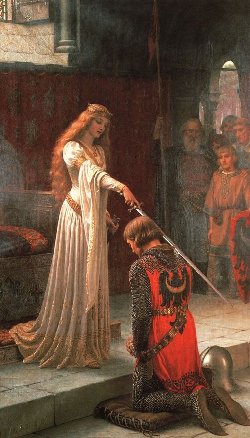
Enchanted CostumesBeautiful costumes, including a dress that looks exactly like the Accolate dress.
Nimue's NeedleLots of medieval and renaisance costumes.
KatherineandAlexandra.comBeautiful medieval and historical wedding gowns.
Chivalry SportsHas lots of costumes and assesories.Great service.
The Pillaged VillageHas costumes and more.
Gryphonsmoon.comBeautiful celtic jewelry and great service.
Sterling siver jewelryNice inexpensive jewelry.
The following is taken from some instructions in the Simplicity pattern 8725. I just thought it was neat and appropirate to this page. Thanks
Silk was introduced during the Crusades, but was so rare and costly only the aristocracy wore it. Very sheer silk woven in Gaza (guaze) was brought home from the holy land and was greatly prized for veils. Pieces of silk cloth were often gifts from one ruler to another. Cotton was just as rare since it was gorwn in Egypt. Undershfits (chemises)and head coverings were made of linen since flax grew successfully in the north. Elaborate brocades belonged to the 14th century and beyond. Many of the fabrics of this time were a solid color or woven with a small, simple repeat motif. Complicated looms were just being invented, especially in the Orient and Italy. Colors were lush and varied for the aristocracy. Dyes were made from all manner of plants and insects, sea creatures, and minerals. Deep shades were the hardest to achieve and thus the most prized. Trimming was often in the form of ribbon braid made on a small loom or hand embroidery. Lace was not invented until the 16th century.
|

 McCall 4378. Long Princess seamed dress with V neck and two sleeve variations, comes with a cape pattern.
 McCall 4490. Long princess seamed dress with wide scoop neck or gathered neck, two sleeve variations.
 McCall 4491. Long princess seamed dress with two sleeve variations and two sleeve-less options and trim.
 McCall 4492. Picture of dress also
  Burda 2484. Elf/fairy costume, has a princess seamed bodice and a two part sleeve with a long trumpet bell lower sleeve.
 McCall 3653. Medieval costume, long, princess seamed dress with 2 sleeve variations and a surcote. Warning: this pattern calls for a LOT of fabric.
 McCall 3663. Medieval/fantasy costume, has princess seams and 3 sleeve variations. Includes a cape with celtic design on back. Inspired by the Mists of Avalon movie, the orange dress looks just like
  Simplicity 9891. Fantasy costume with princess seams, 3 neckline treatments and 2 sleeve variations. Also has a belt pattern. Inspired by the The Lord of the Rings movies.
 McCall 3861. Medieval style wedding gown with princess seams and 2 sleeve variations. Also has a belt pattern.
 Butterick 6593. Empire waist formal with 2 neckline treatments and 2 sleeve variations.
 Butterick 3552. Medieval/fantasy costume, has princess seams and 2 sleeve variations with optional train. I think this one was also inspired by the Mists of Avalon movie, the brown dress looks just like a dress Igraine wears.
 Burda 2509. Medieval costume, long underdress with drawstring/elastic? neckline, bell sleeves and a lace up over bodice.
 McCall 8937. Medieval costume, long, loose dress with overbodice, has large trumpet sleeves. Also includes a cape pattern.
 McCall 4041. Medieval costume, long sress with false lace up bodice and straight sleeves. Includes a hat pattern.
 Butterick 6203. Medieval costume for adult and kids, long princess seamed dress with straight sleeves. Has a headpice pattern.
 McCall 3869. Medieval style wedding gown with empire waist and princess seams. Has 2 sleeve variations.
 Simplicity 8725. Medieval costume, cothehardie and surcote. Warning: This pattern calls for a LOT of fabric.